-
Our Critique of Theistic Evolution Does Not Misrepresent the Biologos Position
In 2017, I was a coeditor for the book Theistic Evolution: a Scientific, Philosophical, and Theological Critique [1]. in my introductory chapter to that book, I defined theistic evolution as follows, using a definition jointly authored by the editors of the book:
God created matter and after that did not guide or intervene or act directly to cause any empirically detectable change in the natural behavior of matter until all living things had evolved by purely natural processes (p. 67).
But after the book was published, some reviews on the Biologos website objected that our definition had misrepresented their position. The primary statement of this objection was in a thoughtful and gracious review by Deborah Haarsma, President of Biologos. She proposed an alternative definition of theistic evolution (though she prefers to call it “evolutionary creation”):
God creates all living things through Christ, including humans in his image, making use of intentionally designed, actively-sustained, natural processes that scientists today study as evolution.
Haarsma adds, “God guided evolution just as much as God guides the formation of a baby from an embryo” (in the previous sentence she had cited Psalm 139:13, which says, “You formed my inward parts; you knitted me together in my mother’s womb”). She also says, “Although God in his sovereignty could have chosen to use supernatural action to create new species, evolutionary creations [sic] are convinced by the evidence in the created order that God chose to use natural mechanisms.”
However, Haarsma’s new definition does not actually conflict with our definition, but rather confirms the essence of our definition given above. We could modify our definition to add more things that she advocates, but the substance of the definition would remain, as in this example:
God created matter [with intentionally designed properties governed by “natural law”] and after that [God continued to sustain matter and preserve its natural properties but he] did not guide or intervene or act directly to cause any empirically detectable change in the natural behavior of matter until all living things had evolved by purely natural processes [which God actively sustained but did not change].
In this modified definition, I have explicitly added the Biologos belief that God actively upholds and sustains the activity of the entire natural world (as affirmed in Col. 1:17 and Heb. 1:3). I agree with that belief. But to define creation this way is to confuse God’s initial work of creation with his ongoing work of providence. (Note the present tense verb in Haarsma’s definition of theistic evolution: not “God created” but “God creates,” thus drawing no distinction between God’s initial creative work at the beginning of the universe and his subsequent sustaining work that continues today.)
The key point in our definition is the theistic evolutionist claim that God did not “cause any empirically detectable change in the natural behavior of matter” until all living things “had evolved by purely natural processes.” Haarsma does not raise any objection to this crucial part of our definition, and in fact her proposed definition affirms the same thing: “God creates all living things… making use of intentionally designed, actively-sustained natural processes.”
In another Biologos review, Jim Stump writes, “Yes, we believe that God guides evolution, the same as we believe God guides photosynthesis.”
But this is a misleading use of the word “guide.” People ordinarily use the word “guide” to refer to an action that influences the course of an object so that it changes the direction it was otherwise going. But the Biologos explanation shows that they use the word “guide” to mean “does not change the direction of an object but sustains it so that it continues in the direction it otherwise was going.” So ordinary English speakers understand “guide” to mean “change the direction of something,” but the Biologos foundation uses the word” guide” to mean “not change the direction of something,” which is just the opposite.
I conclude that our definition of theistic evolution remains accurate. The advocates of theistic evolution who are affiliated with Biologos support a viewpoint that is correctly summarized in this statement:
God created matter and after that did not guide or intervene or act directly to cause any empirically detectable change in the natural behavior of matter until all living things had evolved by purely natural processes.
[1] Edited by J.P. Moreland, Stephen Meyer, Chris Shaw, Ann Gauger, and Wayne Grudem (Wheaton: Crossway, 2017).
[2] See Deborah Haarsma, “A Flawed Mirror: A Response to the Book ‘Theistic Evolution,’” dated April 18, 2018: https://biologos.org/articles/a-flawed-mirror-a-response-to-the-book-theistic-evolution.
[3] See p. 65, n. 6 for a discussion of why we retain the term “theistic evolution.”
[4] Jim Stump, “Does God Guide Evolution?” at https://biologos.org/articles/does-god-guide-evolution.
-
Trump Should Drop Out Now for the Sake of the Country, the Republican Party, and His Own Legacy
I voted for Donald Trump twice. I published several op-ed pieces defending him and his policies. I spoke in support of Trump on podcasts and before live audiences. I do not regret those decisions and I remain convinced that, given the alternatives (Hillary Clinton and Joe Biden), supporting Trump in 2016 and 2020 was the right choice.
What Trump Did Right
I also think that Trump accomplished a remarkable number of good things for America. He placed three outstanding justices on the Supreme Court. He slashed taxes and cancelled thousands of government-imposed regulations, and these two actions spurred vigorous economic growth while bringing inflation down to just over 2% per year. He reduced the flow of illegal immigrants from 297,898 to 143.099 per year. (By way of comparison, under Biden the numbers are 2.76 million for 2022 and 3.2 million so far for 2023.) Trump built over 200 miles of effective border walls and would have built many more miles if construction had not been blocked repeatedly by liberal judges and by a Democratic Congress that refused to appropriate money for a wall.
In addition, President Trump negotiated the Abraham Accords, which established normal diplomatic relationships between Israel and four neighboring Arab countries and gave hope for continuing peace in the Middle East. And he moved the US embassy in Israel from Tel Aviv to Jerusalem. I also note that Russia did not invade Ukraine and Hamas did not invade Israel while Trump was president – they were afraid of how he might respond.
With regard to energy policy, Trump gave approval to the Keystone pipeline, the Dakota access pipeline, and oil production from the Alaska National Wildlife Refuge, a region which could produce up to 20 percent of our petroleum needs. His administration also granted significantly more permits for mining of oil, gas, and coal from federal lands. The result was lower energy prices, a benefit to everyone. (The average price of gas in the United States was $2.42 per gallon in January, 2021, Trump’s last month in office, compared to $3.74 today – a 54% increase under Biden.) At the end of Trump’s term, the US was energy-independent and was on its way to becoming the world’s leading exporter rather than a net importer of energy.
And the list goes on. Trump built a stronger US military, expanded educational freedom, defended freedom of conscience for artistic professionals, defeated ISIS, persuaded several European nations to increase their NATO funding, protected freedom of speech on college campuses, and instructed the Department of Education to protect boys’ and girls’ bathrooms, locker rooms, and sports teams.
Speaking as a professor who has taught theology and ethics for 46 years, I can say that all of these actions seem to me to be consistent with a Judeo-Christian world view as found in the Bible as a whole. And, as an evangelical Christian, I appreciate that Trump welcomed several evangelicals into cabinet posts and other positions of high influence in his administration. (Biden has none in his cabinet so far as I know.)
Democrats Oppose Trump’s Accomplishments
But President Biden has steadily rolled back many of these achievements, and if a Democrat wins the presidency in 2024, more and more will be nullified. Democrats will appoint liberal justices to the Supreme Court and lower courts; they will continually increase taxes; they will fuel inflation with runaway government spending, which will drive our nation ever further into debt. They will place nearly impossible requirements on the use of coal, oil, and natural gas, thereby giving us ever more expensive and less reliable energy. They will keep our borders open because they hope millions of illegal immigrants will eventually become millions of additional Democrat voters. They will also increase their attacks on religious freedom and freedom of conscience. They will continue to weaken our military through relentless cuts to military budgets. If we have to endure another four years of a Democratic president, nearly all of Trump’s legacy will be lost.
Why Trump should drop out now
Why then should Trump drop out of the current presidential race? Because he is a weaker candidate than in 2016. In fact, Republican pollster Frank Luntz recently called Trump the “weakest” Republican candidate for the general election. While Trump remains popular among conservative Republicans (and thus he could win the GOP nomination), his support among independent voters is abysmal, and independents will decide the general election.
The latest Gallup poll showed a remarkable decline in party loyalty for both parties. 28% of Americans now consider themselves Republicans, 24% now consider themselves Democrats, and a whopping 46% say they are “Independents.” A candidate will have to win a majority of Independents in order to win the election. And that is where Trump comes up short.
A New York Times/ Siena College poll of over 3,600 registered voters in six battleground states in October, 2023, found that 57% of respondents had an unfavorable view of President Biden, a highly unpopular president (41% were favorable). But 56%, almost an identical number, had an unfavorable view of Trump (42% were favorable). Voters don’t like either of these candidates. And among voters who are “undecided and persuadable,” only 20% think it would be good for the country if Trump became president again. And 54% believe that Trump has committed serious federal crimes. If those numbers are anywhere near the actual situation, it will be impossible for Trump to win the general election.
Therefore if Trump collects a majority of delegates in the early Republican primaries and thereby secures the GOP nomination, Republicans would be facing a huge risk that Democrats will find some way to dump Biden and then quickly select a fresh, younger candidate (like California governor Gavin Newsome) and win the general election in a landslide.
Seven negative factors that diminish Trump’s support
Here are seven factors that have driven away large numbers of independent voters since the 2020 election:
- Refusing to admit that he lost the 2020 election. I realize that many Trump supporters will object, “But the Democrats cheated!” Okay, I have read enough reports about people inserting fraudulent ballots into the voting process that I will agree that some Democrats in some precincts somehow produced a dishonestly high vote count for Joe Biden. But there are more than 174,000 voting precincts in the United States, and there is now no way to know how many illegitimate votes Biden accumulated. There is also no way to prove that Democrats in any single state fabricated anywhere near enough votes to swing that state’s electoral votes to Biden instead of Trump.
After the 2020 election, Republican lawyers filed more than 60 lawsuits attempting to prove that the electoral votes in some states where Biden won by a narrow margin should instead be awarded to Trump. But in every case, judges ruled that the Republican lawyers had not produced enough evidence even to bring the case to trial, which means there was nowhere near enough evidence to overturn the election in any single state.
The overall popular vote was Biden 81,268,773 and Trump 74,216,728. Biden won the popular vote by over 7 million. Biden had 51.3% of the popular vote and Trump had 46.8%. So, in terms of the popular vote, the election was not even close. Are we to believe that Democrats cast 7,000,000 illegitimate votes without getting caught? (Yes, I realize that electoral votes decide the presidency, not the overall popular vote, but the popular vote is still a general perspective on the mood of the nation. In fact, Biden won 57% of the electoral votes, with 306 against 232 for Trump.)
Many faithful Trump supporters will still believe that the election was “stolen,” and they are entitled to their own beliefs. But I’m concerned that endlessly repeating this claim quickly turns off many independent voters. What they see is a sore loser who refused even to attend President Biden’s inauguration, a long tradition that has served as a model for the rest of the world of the peaceful transfer of power within the world’s most powerful nation. - Recklessly refusing to call off the protesters when the demonstration turned violent on January 6: A strong rebuke from Trump in public and on Twitter, warning the protesters against forcefully entering the capitol, would have avoided the horrible spectacle of American citizens joining an unruly mob that was trying to stop Congress from functioning according to the law and certifying the results of the election.
Here is the relevant timeline: Some protesters pushed aside fencing and overwhelmed police in one section of the capital perimeter at 12:53 PM, another barricade was breached by a large group at 12:57 PM, and other protesters overran three layers of barricades and forced some capitol police to retreat to the capitol steps at 1:03 PM. At 1:50 PM, DC Metropolitan police Cmdr. Robert Glover declared a riot. The first protesters entered into the capitol building at 2:12 PM. Trump should have called off what was becoming an unruly mob at 12:53 PM, but it was not until 2:38 PM that Trump finally Tweeted, “Please support our Capitol Police and Law Enforcement. They are truly on the side of our Country. Stay peaceful!” Even then he did not ask them to leave the building.
Trump was at that time still president of the United States (Biden’s inauguration was not until January 20), and the center of American government was under attack by an unruly mob, and the capitol police were being overwhelmed, and the President of the United States, who could have stopped it, did nothing for more than 1 ½ hours. Many independents will ask, shall we elect this man president again? - Losing Republican control of the U.S. Senate by making rash endorsements of weak Republican candidates in several states: Arizona, Georgia, and Pennsylvania all had incumbent Democrat senators who could have been soundly defeated by a reasonably competent Republican candidate in 2022, but Trump foolishly endorsed Blake Masters in Arizona (who had never held any elective office), Herschel Walker in Georgia (whose credibility was repeatedly challenged), and political newcomer Dr. Mehmet Oz in Pennsylvania. All three states had stronger candidates who would have won the election and would have given Republicans a 53-47 majority in the Senate, but Trump failed to endorse the strong candidates, choosing instead people who agreed with his claim that the election was stolen. This is another reason why there would not be much enthusiasm for Trump candidacy among conservative-leaning independents (and also among many lifelong Republicans).
- Legal problems: The multiple active lawsuits against President Trump (91 felony counts) constitute a huge risk, because they could essentially keep him from actively campaigning during the entire election season of 2024. In addition, the legal discovery process holds the potential of some insiders anonymously leaking a drip-drip-drip of embarrassing and damaging new information about Trump after he wins the Republican nomination and it is too late for Republicans to replace him with a non-scandal plagued candidate. The Democrats could win in a landslide.
Or what if Trump wins the nomination and then is convicted of a felony before the November general election? Fiercely loyal Republicans would still back him but for a large number of moderate voters this would be the final straw, and they would not vote for Trump.
My own view (others may differ) is that the legal charges against Trump do not stem from impartial attempts to pursue equal justice under the law but instead stem from the horrible misuse of prosecutorial authority by Trump-haters who first selected their victim (Donald Trump) and then searched high and low for some crime they could charge him with committing. I think that the charges against Trump are a pernicious misuse of the courts as weapons against political opponents. But the trials will go on, and they must be taken into account.
Already 49% of Americans believe Trump has done something illegal and an additional 26% believe he has done something unethical but not illegal (according to the latest NPR/PBS NewsHour/Marist poll). That makes 55% of voters who have a reason (in their own minds) to vote against Trump because of his legal problems alone. - Age: Trump was born on June 14, 1946, which makes him 77 years old. When compared to President Biden, who at age 81 is obviously frail and out of touch, Trump seems healthy and strong. But compared to other possible Democrat candidates such as Gavin Newsom (age 56), Michelle Obama (age 59), or Pennsylvania Gov. Josh Shapiro (age 50), Trump’s age becomes a significant risk factor. Trump is now eight years older than when he began his successful campaign in 2015 and at age 77 there is always the risk of an unexpected health problem in the middle of a demanding campaign.
- Concerns about Trump’s character: Especially among voters with a strong religious commitment (such as hundreds of my friends who are evangelical Christians), there remains a cloud of concern about Trump’s deepest moral convictions, especially about relationships with women (people remember the Access Hollywood tapes), and also about insufficient care for factual accuracy in what he says, and about his practice of insulting former political allies who now disagree with him. This concern about character cost Trump many thousands and perhaps millions of votes in 2016 and 2020.
- Trump fatigue: Here I speak personally as a lifelong Republican, one who will support any Republican candidate because the policies supported by Republicans are more consistent with the overall teachings of the Bible regarding governments and laws than the policies of the Democrats, in my opinion.
Quite honestly, the thought of having to defend Trump again and again for another year produces in me a great feeling of weariness. Judging from numerous personal conversations, I think millions of other Republicans feel the same way. We would vote for Trump, but the needed enthusiasm and willingness to spend volunteer hours and to contribute money are simply not there.
But what about recent polls?
What about the polls that show Trump ahead of Biden? To me, they mean nothing because I don’t believe for a minute that the leadership of the Democrat Party will allow such an unpopular president as Biden to be their 2024 presidential candidate. I think the Democratic leaders are wrong about many policy convictions, but I don’t think they are politically stupid. They are politically shrewd, and their eventual candidate will be much younger and much more popular.
The mainstream liberal press continues to run stories about Trump’s huge lead among Republican voters and about polls showing that Trump could beat Biden, but I think that is because they recognize Trump’s weakness among the general public. Therefore they want Trump as the Republican candidate, knowing that he would lose the general election. They will mostly hold off on running negative stories about Trump until after he wins the GOP nomination, and then the avalanche will start.
No successful sports team continues to talk about how they can beat their weakest rival, but that is similar to what Republicans are doing if they continue to emphasize Trump’s lead over Biden in recent polls. It means nothing against stronger Democrat opponents.
Will the election be about Trump or about issues and policies?
If Donald Trump becomes the Republican candidate, the election will focus more on Trump than on the policies of the two parties. We will have endless media coverage of Trump’s trial, Trump’s lawyers, Trump’s friends and enemies, Trump’s health, Trump’s conduct on January 6 — and endless media delight in asking speculative questions such as: Could Trump actually go to jail? How could the Secret Service protect Trump in jail? How could Trump meet foreign leaders in his jail cell? Could Trump pardon himself? and so forth. Because he is such a forceful personality, and because he is so controversial, and because any story about him attracts viewers and readers, all of the 2024 election season will be Trump, Trump, Trump stories all year long. Is this really what we want as a nation?
But if Trump drops out and another Republican is nominated, the election will be much more about big issues facing the nation. The election will focus on inflation, taxes, securing the border, crime, support for police, school choice, Israel, Ukraine, our military preparedness, race relations, abortion, climate change, the role of judges, the Supreme Court, the national debt, etc.
And if the campaign is about issues, Republicans will likely win the presidency because the mood of the nation has shifted to much stronger support for Republican policies (for example, smaller government, lower taxes, a secure border, a stronger military, more availability of school choice, judges who interpret but do not create laws, etc.) than for the policies of the Democrats.
Trump’s legacy: Plan A or Plan B?
Donald Trump now faces a difficult choice.
Plan A is that Trump stays in the race and wins the Republican nomination but loses the general election. His legacy then will be that he made a good start in 2017-2021, but after that he and the candidates he supported led the Republicans to defeat in 2020, 2022, and 2024, and all his reforms were lost.
Plan B is that Trump drops out of the race and a younger Republican wins the nomination and the general election. This new president will support policies similar to those that President Trump so effectively advocated. Therefore, Trump’s legacy will be secured. He will be remembered as a remarkable change agent who began to free us from the domination of a federal government that had become far too big and far too powerful.
If Trump follows Plan B, he will still be remembered as a president who brought millions of working class Americans into the Republican fold, including millions of Black and Hispanic voters. He will also be remembered as a president who rebuilt our military, restored the dominance of originalism in our courts, cut taxes, strengthened the economy, showed us how to effectively secure the border, brought new hope for genuine peace in the Middle East, made us the dominant source of world energy, deterred aggression by Rusia and China, defeated ISIS, and did many other good things.
And if he drops out now, Trump will also be remembered as the ex-president who with commendable humility put the good of the country ahead of his own personal ambition and withdrew from the race so that a more electable Republican could become president and could spend the next eight years solidifying the policies that Trump began in 2017-2021.
Yes, dropping out would require a dose of humility, a quality not common among politicians. But humility is frequently recommended in the Bible: “God opposes the proud but gives grace to the humble” (James 4:6; also1 Peter 5:5).
A pardon for Trump
Finally, I hope that the new Republican president on January 20, 2025, will issue a wide-ranging pardon to Trump, thus rebuking the Democrats’ shameful attempts to use the Department of Justice as a political weapon to persecute members of the other party. This is a practice followed in corrupt third world nations, but it is a practice unworthy of this great nation, and no honorable president or political party should tolerate its existence in the United States of America.
- Refusing to admit that he lost the 2020 election. I realize that many Trump supporters will object, “But the Democrats cheated!” Okay, I have read enough reports about people inserting fraudulent ballots into the voting process that I will agree that some Democrats in some precincts somehow produced a dishonestly high vote count for Joe Biden. But there are more than 174,000 voting precincts in the United States, and there is now no way to know how many illegitimate votes Biden accumulated. There is also no way to prove that Democrats in any single state fabricated anywhere near enough votes to swing that state’s electoral votes to Biden instead of Trump.
-
Christian Ethics
Why Did I Write My New Book on Christian Ethics?
by Wayne Grudem
I wrote my new book Christian Ethics (Crossway, 2018) for Christians who want to understand what the Bible teaches about how to obey God faithfully in their daily lives. I hope the book will be useful not only for college and seminary students who take classes in Christian ethics, but also for all other Christians who seek, before God, to be “filled with the knowledge of his will in all spiritual wisdom and understanding,” with the result that they will live “in a manner worthy of the Lord, fully pleasing to him: bearing fruit in every good work and increasing in the knowledge of God” (Col. 1:9–10).
But the book also contains a challenge. I am concerned that teaching about ethics has been neglected in many evangelical churches today—partly because the issues seem complex, partly because pastors do not want to be accused of sounding “legalistic,” and partly because the surrounding non-Christian culture is hostile to Christian moral values, so anyone who teaches biblical ethics is likely to be criticized by unbelievers. Therefore, I hope this book will help to meet a need among Christians today for more biblical ethical understanding. And I hope the book will challenge Christians to live lives of personal holiness in the midst of a secular culture.
This book is similar in its method to my earlier book Systematic Theology, because both books seek to explain “what the whole Bible teaches” about various specific topics. However, Systematic Theology dealt with theological topics such as the Trinity, the person of Christ, the atonement, and salvation, while this book deals with ethical topics such as lying and telling the truth, war, abortion, euthanasia, racial discrimination, divorce and remarriage, homosexuality, stewardship of money, wise use of the environment, and many other topics.
I hope it will be useful for all Christians who seek to experience the great blessing of God that comes from walking daily in paths of obedience, knowing more of the joy of God’s presence, and experiencing his favor on our lives.
Purchase this book -
Theistic Evolution Denies Twelve Creation Events and Undermines Crucial Doctrines
Theistic Evolution denies twelve creation events and undermines crucial doctrines.
Presented at Phoenix Seminary’s Conference, God & Evolution: A Critique of Theistic Evolution, January 18, 2018.
Phx Sem #2.02 TE undermines 12 creation events and several doctrines
-
If We Decide That God Used Evolution to Create Us, What Happens to Genesis 1-3?
If God used evolution to create us, then what happens with Genesis 1-3?
Presented at Phoenix Seminary’s Conference, God & Evolution: A Critique of Theistic Evolution, January 19, 2018.
-
God and Evolution Conference at Phoenix Seminary (Jan. 18-19, 2018)
The debate about biological origins continues to be hotly contested within the Christian church. Prominent organizations such as Biologos (USA) and Faraday Institute (UK) insist that Christians must yield to an unassailable scientific consensus in favor of contemporary evolutionary theory and modify traditional biblical ideas about the creation of life accordingly. They promote a view known as “theistic evolution” or “evolutionary creation.” They argue that God used—albeit in an undetectable way—evolutionary mechanisms to produce all forms of life.Dr Grudem has identified some of the main theological problems with theistic evolution and presents them in the following two powerpoint presentations.
If We Decide That God Used Evolution to Create Us, What Happens to Genesis 1-3?
Phx Sem #1.02 What happens to Gen 1-3
Theistic Evolution Denies Twelve Creation Events and Undermines Crucial Doctrines
Phx Sem #2.02 TE undermines 12 creation events and several doctrines
-
How Do We Solve World Poverty Debate
Debate Dr. Grudem had with Richard Glover on the Bible, poverty and foreign aid
-
I Have Parkinson’s and I Am at Peace
Dec. 20, 2015 (Sunday evening)
Friends,
I am writing to let you know that on Wednesday I saw my family doctor (Dr. Stephen Hoshiwara) with some puzzling symptoms, and he suspected Parkinson’s disease. He referred me to a neurologist (Dr. Nida Laurin), and on Friday, Dec. 18, she confirmed that I definitely have Parkinson’s disease.
This is a progressive neurological disorder for which there is no known cure, but there are medicines that alleviate the symptoms and may slow the progress of the disease. Dr. Laurin started me on one medicine (Rasagiline, made by an Israeli company) that helps some patients and not others. She did not think my symptoms were severe enough to start me on the most common medicine (dopamine), because its effectiveness diminishes over time and she did not want to start it too early.
Starting tomorrow (Monday), we will begin the process of seeking an appointment at Barrow Neurological Institute, which is (according to Wikipedia) “the world’s largest neurological disease treatment and research institution,” and is here in Phoenix.
The symptoms that I have now include a diminishing of fine motor control, so that my handwriting is less legible and more crowded together, and in typing I sometimes hit a key twice or not at all, and my mouse control is not as precise with the computer. It’s also harder to button my shirts, and I sometimes feel a tiny tremor when I reach for things. I can still do all these things, but they are a bit slower and take more concentration. In addition, I seem to be moving my arms and legs more slowly in ordinary daily activities. And Margaret says that sometimes my facial expression seems a bit “fallen,” and I notice that it’s harder to smile. In recent photos my smile has not seemed as genuine or natural, but more forced.
The symptoms and the rate of progression of the disease very widely from patient to patient, and are apparently impossible to predict. Sometimes the progression is very slow, as with Billy Graham who has had Parkinson’s for 26 years (he is now 96). Michael J. Fox also has Parkinson’s, and has continued to function. In other people, however, the disease progresses more quickly.
How are we doing? Margaret has been a wonderful help and encouragement, and she keeps reminding me that “we’re in this together.” She is an amazing, most wonderful wife.
We both feel a deep peace from the Lord about this. King David said to the Lord, “My times are in your hand” (Ps. 31:15), and I truly feel that way. Parkinson’s usually does not shorten a person’s life expectancy very much, but in any case, I’m happy to live as long as the Lord wills that I live, and to keep on being productive for as long as he enables me to do so. “In your book were written, every one of them, the days that were formed for me, when as yet there was none of them” (Ps. 139:16).
But I would like, if God allows, to finish my current major writing projects –
(1) a textbook on Christian ethics (which I hope will take me about one more year to finish after the first draft is done, or until Jan., 2017), and
(2) a revised edition of my book Systematic Theology (this should take from 2017 to 2019).
After that, I was sort of wondering what I was going to do anyway. 🙂
I do plan to continue to teach at Phoenix Seminary, so long as I am able to teach effectively. (The seminary will be moving in July, 2017, to a new location in a new building to be built on the site of the old Scottsdale Bible Church chapel on Shea Boulevard – just 12 minutes from our house!)
Here are some other verses which the Lord has brought to my mind a number of times in the last year, and which seem especially appropriate now:
“So teach us to number our days that we may get a heart of wisdom” (Psa 90:12). (I need to be a wise steward of my remaining days.)
“For David, after he had served the purpose of God in his own generation, fell asleep” (Acts 13:36). (All I want to do is to serve the purpose of God for me in my generation.)
“And say to Archippus, “See that you fulfill the ministry that you have received in the Lord.” (Col 4:17).
This last verse has been especially forceful in my mind for the last year or so – I deeply want to “fulfill the ministry that [I] have received in the Lord,” which I understand to be the ethics textbook and the Systematic Theology revision.
Then on a personal level, I am concerned to make wise plans so that Margaret will be well cared for if the time should come when I am unable to work and to help with ordinary tasks.
Other verses that have become more meaningful in the last two days:
But our citizenship is in heaven, and from it we await a Savior, the Lord Jesus Christ, 21 who will transform our lowly body to be like his glorious body, by the power that enables him even to subject all things to himself (Phil. 3:20). (My hope of a perfect, Christ-like, resurrection body is even stronger now.)
So we do not lose heart. Though our outer self is wasting away, our inner self is being renewed day by day. 17 For this light momentary affliction is preparing for us an eternal weight of glory beyond all comparison (2 Cor. 4:16). (Parkinson’s is a “light momentary affliction” in the light of eternity.)
Whom have I in heaven but you? And there is nothing on earth that I desire besides you. 26 My flesh and my heart may fail, but God is the strength of my heart and my portion forever (Psalm 73:25). (My personal fellowship with God is far more precious than any measure of physical health, and I deeply and truly feel that right now.)
If you think of it, I would appreciate your prayers for the projects I mentioned above, and for continuing good medical care, and also, if the Lord wills, for partial or full healing, whether through medicine or through his miraculous intervention. I am at peace.
Wayne Grudem
(nothing in this letter is confidential)
-
The Eighth Commandment as the Moral Foundation for Property Rights, Human Flourishing, and Careers in Business
ABSTRACT:
The Eighth Commandment, “You shall not steal,” has massive implications for human life on earth. Exodus 20:15 provides the necessary foundation for system of private ownership of property, of stewardship and accountability, and of an expectation of human flourishing. This article also argues that “business as mission” is a legitimate calling and that founding and running a profitable and ethical business glorifies God.
-
Why Pastors Should Preach about Political Policies
Wayne Grudem at the Watchmen on the Wall Conference in Washington DC, a conference for pastors and church leaders sponsored by the Family Research Council (June 21, 2015)
-
Why, When, and For What Should We Draw New Boundaries? in Beyond the Bounds: Open Theism and the Undermining of Biblical Christianity (2003)
“Why, When, and For What Should We Draw New Boundaries?” in Beyond the Bounds: Open Theism and the Undermining of Biblical Christianity, edited by John Piper, Justin Taylor, and Paul Helseth (Wheaton: Crossway, 2003), pp. 339-370. Used by permission of Crossway, a publishing ministry of Good News Publishers, Wheaton, IL 60187, www.crossway.org. Download for personal use only. Why, When, and for What2
-
Gay Marriage Roundtable Discussion
European Leadership Forum, Wisla, Poland, May, 2013
-
Are Only Some Words of Scripture Breathed Out By God? Why Plenary Inspiration Favors ‘Essentially Literal’ Bible Translation
Taken from Translating Truth edited by W.Grudem et al. © 2005. Used by permission of Crossway, a publishing ministry of Good News Publishers, Wheaton, IL 60187, www.crossway.org. Download for personal use only.
-
Interview About My Life and Background
Interview About My Life and Background, Interviewed by Dr. Peter Williams at European Leadership Forum, Wisla, Poland, May, 2013
-
-
Should We Move Beyond the New Testament to a Better Ethic? An Analysis of William Webb’s Redemptive Movement Hermeneutic (2004)
An Analysis of William J. Webb, Slaves, Women & Homosexuals: Exploring the Hermeneutics of Cultural Analysis (Downers Grove: InterVarsity, 2001).
By Wayne Grudem, Phoenix Seminary, Scottsdale, AZ Presented Nov. 19, 2003 at ETS 55th Annual Meeting, Atlanta, Georgia
How can Christians today know which parts of the Bible are “culturally relative” and which parts apply to all believers in all cultures throughout history?
-
Systematic Theology
(1291 pages. This book is widely used as a theology textbook around the world. It has sold over 500,000 copies and has been translated into fifteen other languages, with at least four more foreign translations now in process — see Questions page for translation details.)
The Christian church has a long tradition of systematic theology, that is, studying theology and doctrine organized around fairly standard categories such as the Word of God, redemption, and Jesus Christ. This introduction to systematic theology has several distinctive features: – A strong emphasis on the scriptural basis for each doctrine and teaching – Clear writing, with technical terms kept to a minimum – A contemporary approach, treating subjects of special interest to the church today – A friendly tone, appealing to the emotions and the spirit as well as the intellect – Frequent application to life – Resources for worship with each chapter – Bibliographies with each chapter that cross-reference subjects to a wide range of other systematic theologies.
Purchase this book -
Politics – According to the Bible
(This is a 619-page reference work that discusses over 60 political issues today, grouped into 18 broad categories in its 18 chapters. You can read the entire book, or each chapter can be read on its own for areas such as national defense, the environment, economics, marriage, the protection of life, or the courts.)
Purchase this book
A variety of perspectives exist within the Christian community when it comes to political issues and political involvement. This comprehensive and readable book presents a political philosophy from the perspective that the Gospel pertains to all of life, so Christians should be involved in political issues. In brief, this is an analysis of conservative and liberal plans to do good for the nation, evaluated in light of the Bible and common sense.
In this ground-breaking book, recognized evangelical Bible professor Wayne Grudem rejects five mistaken views about Christian influence on politics: (1) ‘compel religion,’ (2) ‘exclude religion,’ (3) ‘all government is demonic,’ (4) ‘do evangelism, not politics,’ and (5) ‘do politics, not evangelism.’ He proposes a better alternative: (6) ‘significant Christian influence on government.’ Then he explains the Bible’s teachings about the purpose of civil government and the characteristics of good or bad government. Does the Bible support some form of democracy? Should judges and the courts hold the ultimate power in a nation? With respect to specific political issues, Grudem argues that most people’s political views depend on deep-seated assumptions about several basic moral and even theological questions, such as whether God exists, whether absolute moral standards can be known, whether there is good and evil in each person’s heart, whether people should be accountable for their good and bad choices, whether property should belong to individuals or to society, and whether the purpose of the earth’s resources is to bring benefit to mankind. After addressing these foundational questions, Grudem provides a thoughtful, carefully-reasoned analysis of over fifty specific issues dealing with the protection of life, marriage, the family and children, economic issues and taxation, the environment, national defense, relationships to other nations, freedom of speech and religion, quotas, and special interests. He makes frequent application to the current policies of the Democratic and Republican parties in the United States, but the principles discussed here are relevant for any nation. -
“Free Grace” Theology: 5 Ways It Diminishes the Gospel
Must the gospel message include a call for people to repent of their sins? “No,” say Free Grace advocates. Is evidence of a changed life an important indication of whether a person is truly born again? “No, again,” these advocates say. But in this book, Wayne Grudem shows how the Bible answers “Yes” to both of these questions, arguing that the Free Grace movement contradicts both historic Protestant teaching and the New Testament itself. This important book explains the true nature of the Christian gospel and answers the question asked by so many people: “How can I know that I’m saved?”
Purchase this book -
Welcome

On this site you will find an extensive (and growing) collection of articles, books, audio and video messages, and answers to questions by Wayne Grudem. Wayne Grudem is Professor of Theology and Biblical Studies at Phoenix Seminary, Phoenix, Arizona. He has published twenty-two books, including his newest book, Christian Ethics, which was published in July 2018. He was also the General Editor for the ESV Study Bible (Evangelical Christian Publishers Association Book of the Year, 2009). Read more about Wayne Grudem.
-
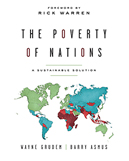
The Poverty of Nations: A Sustainable Solution
This 2013 book was co-authored by me and by my good friend Barry Asmus, a professional economist. (Barry and I have also served together as elders at Scottsdale Bible Church.) For more information about Barry Asmus see http://www.barryasmus.com/In writing The Poverty of Nations, we found that our different academic backgrounds (Barry in economics, Wayne in Christian theology and biblical studies) led us to agree on the only way to solve world poverty.Our solution is a complex one, ultimately involving seventy-eight factors. This is because we are convinced that the causes of continuing poverty are also complex. These seventy-eight factors fall in three categories that affect an entire nation: national laws, economic policies, and cultural values.
We think this book is unique because (a) it approaches world poverty from the combined perspective of Christian theology and economics, and (b) it approaches the question of poverty not at the level of the individual person or community (where much good work is already being done), but at the level of the whole nation.
Purchase this book at Barnes & Noble.com: http://www.barnesandnoble.com/w/the-poverty-of-nations-barry-asmus/1113942799?ean=9781433539114
Purchase this book at Christian Book Distributors: http://www.christianbook.com/the-poverty-of-nations-sustainable-solution/barry-asmus/9781433539114/pd/539114?item_code=WW&netp_id=1121405&event=ESRCG&view=details
Purchase this book at Amazon: http://www.amazon.com/The-Poverty-Nations-Sustainable-Solution/dp/143353911X/ref=sr_1_1?ie=UTF8&qid=1376144541&sr=8-1&keywords=grudem+poverty
Purchase this book -
Christian Beliefs
(This is a 159-page condensation of my book Bible Doctrine, and it covers the 20 most central and basic doctrines of the Christian faith. It is suitable for use in a new members’ class in a church, or in a home study group.)
God doesn’t call every Christian to go off to seminary, but there are certain matters of doctrine—that is, the church’s teaching—that every Christian simply must know. Theology is important, because what we believe affects how we live. If you’re a relatively new believer in Jesus, or if you’re a more mature Christian looking for a quick brush-up on basics of the faith, Christian Beliefs is for you. This readable guide to twenty basic Christian beliefs is a condensation of Wayne Grudem’s award-winning book on systematic theology, prized by pastors and teachers everywhere. He and his son, Elliot, have boiled down the essentials of Christian theology for the average layperson and made them both clear and applicable to life. You will learn about the Bible, the characteristics of God, what it means that we are created in the image of God, what God has done for us in Christ, the purpose of the church, and much more. Each chapter includes questions for personal review or group discussion.
“These truly are twenty basic beliefs that every Christian should know. Wayne Grudem is a master teacher with the ability to explain profound truths in simple language. He is a man of deep conviction and theological passion—and those who read this book will be both educated and encouraged in the faith.” -R. Albert Mohler Jr., President, The Southern Baptist Theological Seminary, Louisville, Kentucky
“Based on Systematic Theology, this summary will certainly help beginners with Christ to get the hang of their faith.” -J. I. Packer, Regent College, Vancouver, British Columbia
“As Wayne Grudem’s Systematic Theology contracts into a compact book, I do not lose my enthusiasm for the truth he loves and the clarity of his words.” -John Piper, Bethlehem Baptist Church, Minneapolis, Minnesota
Purchase this book -
Business for the Glory of God
Purchase this book(96 pages) Can business activity in itself be morally good and pleasing to God? Sometimes business can seem so shady–manipulating the “bottom line,” deceiving the consumer, or gaining promotions because of whom you know.
But Wayne Grudem introduces a novel concept: business itself glorifies God when it is conducted in a way that imitates God’s character and creation. He shows that all aspects of business,including ownership, profit, money, competition, and borrowing and lending, glorify God because they are reflective of God’s nature.Though Grudem isn’t naïve about the easy ways these activities can be perverted and used as a means to sin, he knows that Christians can be about the business of business.
This biblically-based book is a thoughtful guide to imitating God during interactions with customers, coworkers, employees, and other businesses. See how your business, and your life in business,can be dedicated to God’s glory.
-
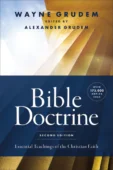
Bible Doctrine
(This is a 528-page condensation of my book Systematic Theology.)
How do we know the Bible is God’s Word? What is sin, and where did it come from? How is Jesus fully God and fully man? What are spiritual gifts? When and how will Christ return? If you’ve asked questions like these, then ‘systematic theology’ is no abstract term. It’s an approach to finding answers every Christian needs to know. Bible Doctrine takes a highly commended upper-level textbook on systematic theology and makes it accessible to the average reader. Abridged from Wayne Grudem’s award-winning Systematic Theology, Bible Doctrine covers the same essentials of the faith, giving you a firm grasp on seven key topics: The Doctrine of the Word of God, The Doctrine of God, The Doctrine of Man, The Doctrine of Christ, The Doctrine of the Application of Redemption, The Doctrine of the Church, and The Doctrine of the Future. Like Systematic Theology, this book is marked by its clarity, its strong scriptural emphasis, its thoroughness in scope and detail, and its treatment of such timely topics as spiritual warfare and the gifts of the Spirit. But you don’t need to have had several years of Bible school to reap the full benefits of Bible Doctrine. It’s easy to understand…and it’s packed with solid, biblical answers to your most important questions.
Purchase this book -
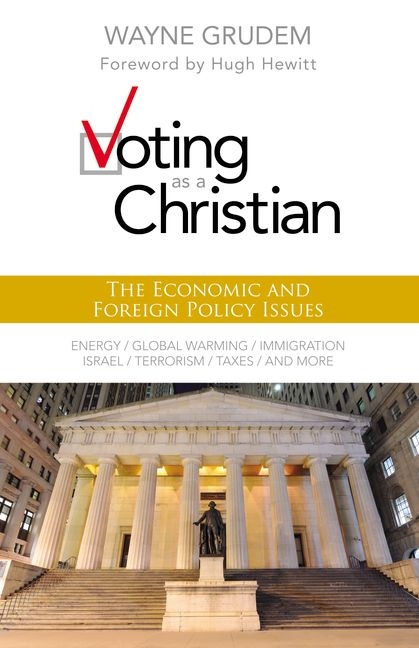
Voting as a Christian: The Economic and Foreign Policy Issues
(This 332-page book contains the chapters on economics, the environment, defense, and foreign policy from my larger book Politics — According to the Bible. It also contains a shortened overview of the early chapters on biblical principles for Christian influence on government in general.)
Voting by the Bible: The Economic and Foreign Policy Issues begins with the assumption that God intended the Bible to give guidance to every area of life—including how governments should function. Derived from Politics According to the Bible, this book highlights those economic and foreign-policy issues that have dominated political debate recently. Throughout, author Wayne Grudem supports political positions that would be called more ‘conservative’ than ‘liberal.’ However, ‘it is important to understand that I see these positions as flowing out of the Bible’s teachings rather than positions I hold prior to, or independently of, those biblical teachings,’ he writes. ‘My primary purpose in the book is not to be liberally or conservative, or Democrat or Republican, but to explain a biblical worldview and a biblical perspective on issues of politics, law, and government.’
Purchase this book -
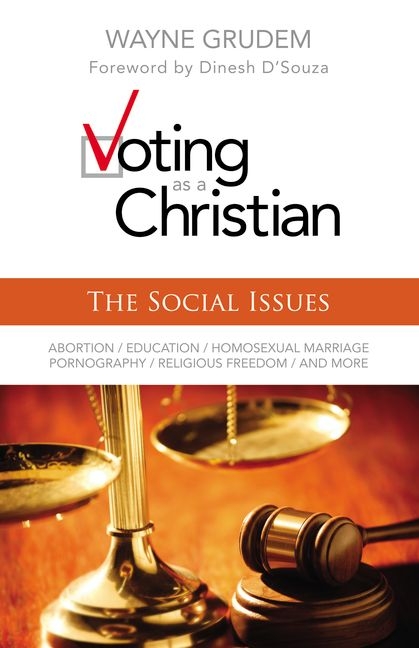
Voting as a Christian: The Social Issues
(This 218-page book contains the chapters on the protection of life, marriage, the family, freedom of speech, and freedom of religion from my larger book Politics — According to the Bible. It also contains a shortened overview of the early chapters on biblical principles for Christian influence on government in general.)
Voting as a Christian: The Social Issues begins with the assumption that God intended the Bible to give guidance to every area of life—including how governments should function. Derived from Politics—According to the Bible, this book highlights those economic and foreign-policy issues that have dominated political debate recently. Throughout, author Wayne Grudem supports political positions that would be called more ‘conservative’ than ‘liberal.’ However, ‘it is important to understand that I see these positions as flowing out of the Bible’s teachings rather than positions I hold prior to, or independently of, those biblical teachings,’ he writes. ‘My primary purpose in the book is not to be liberal or conservative, or Democrat or Republican, but to explain a biblical worldview and a biblical perspective on issues of politics, law, and government.’
Purchase this book -
Recovering Biblical Manhood and Womanhood
Purchase this book(co-edited with John Piper)
(566 pages. This book contains 27 essays by 22 different authors on the key issues regarding biblical manhood and womanhood. It won the “Book of the Year” award from Christianity Today magazine in 1992. In the modern controversies over this topic, this is the book that first defined and defended in detail the “complementarian” position, which says that men and women are equal in value but different in their roles in marriage and the church. For over 20 years this book has remained the standard scholarly work explaining the complementarian position.)
A controversy of major proportions has spread through the church. Recent generations bear witness to the rise of “evangelical feminism”–a movement that has had a profound impact on all of life,challenging some of our basic Christian beliefs.
In this new edition of an influential and award-winning best-seller, more than twenty men and women have committed their talents to produce the most thorough response yet to this modern movement. Combining systematic argumentation with popular application, this volume deals with all of the main passages of Scripture brought forward in this controversy regarding gender-based role differences.
Anyone concerned with the fundamental question of the proper relationship between men and women in home, church, and society will want to read this book. New preface included.
-
An Evaluation of Gender Language in the 2011 Edition of the NIV Bible (2011)
According to the Christian Booksellers Association, the NIV is the best-selling Bible in English—ahead of the King James Version, the New King James Version, the New Living translation, the English Standard Version, the New American Standard, and several others.
But now Zondervan, the publisher of the NIV, has issued a new edition, the 2011 NIV. This edition will replace the current NIV (the 1984 edition). What is this new edition like? (Wayne Grudem was a consultant on this article, which was published by the Council on Biblical Manhood and Womanhood.)
-
FOREWORD to: Should Christians Embrace Evolution (2009)
edited by Norman Nevin (Nottingham, UK: IVP, 2009)
-
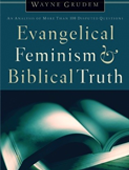
Evangelical Feminism and Biblical Truth
(856 pages. This book complements the materials found in Recovering Biblical Manhood and Womanhood by providing detailed answers to multiple objections that were raised in the thirteen years of intensive discussion and debate from 1991 to 2004.)
Egalitarians, or evangelical feminists, consider men’s and women’s roles in the home and church to be interchangeable. In this helpful book, Bible scholar Wayne Grudem considers over a hundred egalitarian arguments and finds them contrary to the Bible. According to Grudem, the Bible teaches that God values men and women equally. However, their roles in home and church are complementary to each other, not interchangeable. Arguing against both feminism on the left and male chauvinism on the right, his carefully researched handbook is a valuable resource defending the complementarian viewpoint.
Follow this link for Dr. Grudem’s Books At a Glance interview, published on 8/5/14: Click Here
Purchase this book
-
The Art of Marriage
FamilyLife filmed Wayne and Margaret for a new video marriage conference called The Art of Marriage. Wayne was a key contributor to this project, offering relevant biblical insight as a part of the panel of experts, as well as sharing some of his own story of his move to Phoenix. In this particular clip, Wayne and Margaret tell the story of how Scripture influenced their decision to move. The producers of the series explained why they asked Wayne to be involved: “We had a goal of including as much ‘real life’ in this project as we could. In the session on biblical roles in marriage, we wanted to illustrate what it means practically for a man to “love his wife as himself” (Eph. 5:33). We had heard Wayne share about moving to Phoenix primarily for his wife’s health and thought it would be the perfect fit.”
-
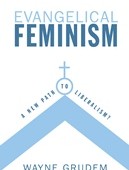
Evangelical Feminism: A New Path to Liberalism?
(272 pages. This 2006 book is intended to sound a warning to churches today. It has 26 short chapters showing that every one of the 26 major arguments used to support evangelical feminism either (a) undermines or denies the authority of the Bible, or (b) is based on untruthful or unsubstantiated factual claims. Then the book argues that the feminist view is dangerous because it inevitably leads churches toward adopting liberal theology and abandoning more and more of the teachings of the Bible.)
By critically examining the writings of egalitarians, Grudem shows that, while egalitarian leaders claim to be subject to Scripture in their thinking, what is increasingly evident in their actual scholarship and practice is an effective rejection of the authority of Scripture.
Egalitarianism is heading toward an Adam who is neither male nor female, a Jesus whose manhood is not important, and a God who is both Father and Mother, and then maybe only Mother. The common denominator in all of this is a persistent undermining of the authority of Scripture in our lives. Grudem’s conclusion is that we must choose either evangelical feminism or biblical truth. We can’t have it both ways!
Purchase this book -
Trinity Debate: Does the Son Eternally Submit to the Father in the Trinity?
Debate on whether the Son eternally submits to the Father in the Trinity
(Wayne Grudem and Bruce Ware vs. Thomas McCall and Keith Yandell)
Trinity Evangelical Divinity School, Deerfield, Illinois, Oct. 9, 2008 -
Why Theology Is Important
Dr. Wayne Grudem, Research Professor of Theology and Biblical Studies at Phoenix Seminary, speaks on “Why Theology is Important”. This lecture took place on October 28th, 2010 at the Arizona Biltmore. This video is part 1 of 3.
-
BIBLICAL REASONS FOR SENDING CHILDREN TO A CHRISTIAN SCHOOL (1985)
Biblical Reasons for Sending Children to a Christian School
The main reason my wife, Margaret, and I sent our children to our local Christian school was a conviction that Scripture directs Christian parents to give their children a Bible-based education whenever they have opportunity to do so. I have listed here six biblical principles which we found very persuasive.
-
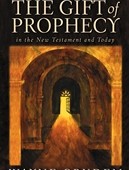
The Gift of Prophecy in the New Testament and Today
(400 pages. This book, published in 1988 and updated in 2000, is a popularized version of my Ph.D. thesis at the University of Cambridge, England. I removed a lot of the technical academic details and added a lot of practical material about guidelines for using this gift today. For the actual text of the doctoral thesis on which this was based, see my book The Gift of Prophecy in 1 Corinthians, below. )
What does the New Testament teach about the spiritual gift of prophecy? What is it? How does it function? Can evangelical Christians use it in their churches today?
This updated, comprehensive work answers such questions and points the way to a renewed understanding of the gift of prophecy–an understanding that suggests how the body of Christ may enjoy one of the Holy Spirit’s most edifying gifts without compromising the supremacy of Scripture.
“This conservative evangelical scholarly work gives a solid theological basis for further development of a practical theology of spiritual gifts.” –John Wimber, Vineyard Christian Fellowship
“Careful, thorough, wise, and to my mind, convincing.” –J.I. Packer
“…a fresh, biblically sound, readable contribution…its depth of scholarship, pastoral solidity, and cautions against abuses are special strengths. Highly recommended.” –Vern S. Poythress, Professor of New Testament Interpretation, Westminster Theological Seminary
“If Grudem’s convincing thesis could be heard, a new path of dialog could perhaps be opened up in the Christian community. The research, clarity, and typical Grudem candor continue to make this the finest book on the subject to date.” –L. Russ Bush, Professor of Philosophy of Religion, Southeastern Baptist Theological Seminary
“…thorough, biblical, and practical. It deserves the attention of all who are concerned about the spiritual development of the church today.” –Stanley Horton, Distinguished Professor Emeritus of Bible and Theology, Assemblies of God Theological Seminary
Purchase this book -
A Theology of Work/Vocation
Theologian Wayne Grudem discusses the intersection of work and ministry.
This video is a part of the Leadership Lecture Series, and was recorded September 15, 2011 at the Talbot School of Theology Faculty Retreat in La Quinta, CA
-
Early History of Christian Heritage Academy, Northbrook, Illinois (1985)
Many of us thought that Christian Heritage Academy began in September of 1982, when five couples met at the home of Jim and Linda Lindberg in Lincolnshire, Illinois, to discuss the possibility of starting a Christian school in the north suburban Chicago area. But later we discovered that, in a way unknown to us, the school had begun long before that in the unseen work of God.
-
1 Peter (Tyndale New Testament Commentary series)
In 1 Peter, explains Wayne Grudem, readers are encouraged to grow in their trust in God and their obedience to him throughout their lives, but especially when they suffer. “Here is a brief and very clear summary both of the consolations and instructions needful for the encouragement and direction of a Christian in his journey to Heaven, elevating his thoughts and desires to that happiness, and strengthening him against all opposition in the way, both that of corruption within, and temptations and afflictions from without,” says Archbishop Robert Leighton in the introduction. The Tyndale New Testament Commentaries have long been a trusted resource for Bible study. Written by some of the world’s most distinguished evangelical scholars, these twenty volumes offer clear, reliable, and relevant explanations of every book in the New Testament. These Tyndale volumes are designed to help readers understand what the Bible actually says and what it means. The introduction to each volume gives a concise but thorough description of the authorship, date, and historical background of the biblical book under consideration. The commentary itself examines the text section by section, drawing out its main themes. It also comments on individual verses and deals with problems of interpretation. The aim throughout is to get at the true meaning of the Bible and to make its message plain to readers today. The original, unrevised text of this volume has been completely retypeset and printed in a larger, more attractive format with the new cover design for the series.
Purchase this book -
Are Miraculous Gifts for Today? Four Views
Are the gifts of tongues, prophecy, and healing for today? No, say cessationists. Yes, say Pentecostal and Third Wave Christians. Maybe, say a large sector of open-but-cautious evangelicals. What’s the answer? Is there an answer?
Are Miraculous Gifts for Today? takes you to the heart of the charismatic controversy. It contains thoughtful articles by four authors representing (1) the Pentecostal, (2) the Third Wave, (3) the Open-but-cautious, and (4) the Cessationist positions.
The authors present their positions in an interactive setting that allows for critique, clarification, and defense. This thought-provoking book will help Christians on every side of the miraculous gifts debate to better understand their own position and the positions of others.
“Wayne Grudem has brought online the four major views on miraculous gifts today. Downloading them into your own understanding takes effort, but the worldwide network that you join is the fellowship of the Spirit!” — Edmund Clowney, Professor of Practical Theology, Emeritus, Westminster Theological Seminary
“No heaven-sent resource is more intended to bond and bless the church than the Holy Spirit’s gifts and ministry. Hopefully, this excellent book will help all the more to achieve his intent — our bonding as one body and our blessing by the Spirit’s manifest presence.” — Jack W. Hayford, Senior Pastor, The Church on the Way, Van Nuys, CA
Purchase this book -
Questions and Answers on “Politics According to the Bible”
Alliance Defense Fund – Q&A with Dr. Wayne Grudem about his new book: “Politics according to the Bible”
-
Why It Is Never Right To Lie: An Example of John Frame’s Influence on My Approach to Ethics (2009)
Wayne Grudem
Research Professor of Theology and Biblical Studies, Phoenix Seminary, Phoenix, Arizona[published as: “Why It Is Never Right to Lie: An Example of John Frame’s Influence on My Approach to Ethics,” in Speaking the Truth in Love: The Theology of John Frame (Festschrift for John Frame), edited by John J. Hughes (Phillipsburg, NJ: P & R, 2009), pp. 778-801]
-
Thoughts on the book Systematic Theology
The Christian church has a long tradition of systematic theology, that is, studying theology and doctrine organized around fairly standard categories such as the Word of God, redemption, and Jesus Christ. This introduction to systematic theology has several distinctive features: – A strong emphasis on the scriptural basis for each doctrine and teaching – Clear writing, with technical terms kept to a minimum – A contemporary approach, treating subjects of special interest to the church today – A friendly tone, appealing to the emotions and the spirit as well as the intellect – Frequent application to life – Resources for worship with each chapter – Bibliographies with each chapter that cross-reference subjects to a wide range of other systematic theologies.
-
Which Bible Translation Should I Use? (new, October, 2012)
One of the most frequently asked questions related to the Bible is, “Which Bible translation should I use?” People often wonder what is the all-around best English Bible translation available. In this book, veteran Bible translators Douglas Moo, Wayne Grudem, Ray Clendenen, and Philip Comfort all analyze the same “test” passages, and each author makes a case for the Bible translation he represents: the NIV 2011 (New International Version), the ESV (English Standard Version), the HCSB (Holman Christian Standard Bible), and the NLT (New Living Translation) respectively.
Purchase this book -
WHAT ARE THE CONSEQUENCES OF DIVORCE?
A Summary of Some of the Findings in the Book: Second Chances: Men, Women, & Children a Decade After Divorce by Judith S. Wallerstein & Sandra Blakeslee (New York: Ticknor & Fields [Houghton Mifflin], 1989)
Wayne Grudem, Ph.D.
Professor of Biblical and Systematic Theology Trinity Evangelical Divinity School Deerfield, Illinois
July 31, 1996 -
Biblical Foundations for Manhood and Womanhood (editor)
(304 pages. This book contains 10 foundational papers that were presented March 20-22, 2000, at a conference sponsored by the Council on Biblical Manhood and Womanhood in Dallas, Texas.)
For years a debate has raged over how to define true masculinity and true femininity. While there is agreement that men and women share equally in the privilege of being made in God’s image, some views of manhood and womanhood blur God-given gender distinctions.
Wayne Grudem assembled a team of distinguished writers to show how egalitarian views destroy God’s ideal for your relationships,marriage, and life purposes. The contributors to this book include:
- John Piper, Pastor of Bethlehem Baptist Church, Minneapolis,Minnesota
- Bruce A. Ware, Senior Associate Dean of the School of Theology and Professor of Christian Theology at The Southern Baptist Theological Seminary
- Richard W. Hove, Director of Campus Crusade for Christ at Duke University
- Daniel Doriani, Dean of the Faculty and Professor of New Testament at Covenant Theological Seminary
- Daniel R. Heimbach, Professor of Christian Ethics at Southeastern Baptist Theological Seminary
- Peter Jones, Professor of New Testament at Westminster Theological Seminary in California
These writers explore key issues, including the interchangeability of male-female roles, the meaning of submission,and the historical novelty of egalitarian interpretations of Scripture. This book will demonstrate how some views of manhood and womanhood tamper with our understanding of God’s character and why the extremes of male domination and feminism destroy the beauty of our sexual differences-differences that celebrate the excellence of men and women as God created us.
Purchase this book -
What is unique about Phoenix Seminary?
Dr. Wayne Grudem, Research Professor at Phoenix Seminary, talks about Phoenix Seminary’s ministry philosophy, “Scholarship with a Shepherd’s Heart”. This is part 1 of 3 parts. Part 1 is on “Scholarship”.
-
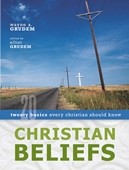
Christian Beliefs: 20-part DVD course
Christian Beliefs is a new DVD discipleship resource with world class theologian, Dr. Wayne Grudem. Grudem’s books are used in seminaries all over the world to train pastors and leaders. But now the rules have changed. Grudem’s powerful, heartfelt teaching can be in your living room!
Many resonate with the apostle Paul’s heart cry, “that I may know him and the power of His resurrection.” If you are one of them, or you want to be, this is for you.
Purchase this book -
What books have most strongly influenced you?
Books that strongly influenced me:
After book (1) below, it is an impossible question for me to answer exactly. Many books have influenced me at different times. Here are eleven that influenced me quite early in my Christian life (all but #3 and #10 and #11 while I was still in college, before I went to seminary), plus #12, which influenced me many years later.
(1) The Bible, far beyond all other books combined.
(2) John Calvin, Institutes of the Christian Religion
(3) Louis Berkhof, Systematic Theology
(4) J. Gresham Machen, Christianity and Liberalism
(5) Cornelius VanTil, The Defense of the Faith
(6) D. M. McIntyre, The Hidden Life of Prayer
(7) John Murray, Principles of Conduct
(8) John Murray, Redemption: Accomplished and Applied
(9) B. B. Warfield, The Plan of Salvation
(10) B. B. Warfield, The Inspiration and Authority of the Bible
(11) Geerhardus Vos, Biblical Theology
(12) John Wimber, Power Evangelism -
Should Christians Be Involved in Politics and Government?
Alliance Defense Fund – Q&A with Dr. Wayne Grudem talking about his new book “Politics according to the Bible” Question #5
Question: Should Christians be involved in politics & government?
-
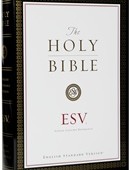
ESV Bible (member of Translation Oversight Committee)
The English Standard Version (ESV) Bible is an essentially literal Bible translation that combines word-for-word accuracy with literary excellence, beauty, and depth of meaning.
First published in 2001, the ESV Bible has become trusted by millions of Christian leaders, pastors, and individuals in every part of the world.
The ESV Bible carries forward the trusted legacy of the Bible in English–the legacy established first in the Tyndale New Testament (1526) and the KJV Bible (1611). With this legacy as the foundation, the ESV Bible (2001) reflects the beauty and majesty of the original languages, first captured centuries ago by these early Bible translations.
But the ESV also provides the most recent evangelical Christian Bible scholarship and enduring readability for today. The ESV translation team was built on the trusted foundation of over 100 evangelical Christian scholars and pastors worldwide, committed to the truth, authority, and application of the Bible to all of life.
Purchase this book -
Do you have any books to recommend on a Christian view of economics?
My first recommendation is Jay Richards’ excellent book, Money, Greed, and God: Why Capitalism is the Solution and Not the Problem (New York: HarperOne, 2009). In addition, see my annotated list of other helpful (and not so helpful) books on economics here:
- 1. David Landes, The Wealth and Poverty of Nations: Why Some Are So Rich and Some So Poor. (1999). Landes is professor emeritus of economics at Harvard and also taught at George Washington University. This is a masterful survey of the history of economic development in the entire world, by region, over the last 500 years.
- 2. Lawrence E. Harrison, The Central Liberal Truth: How Politics Can Change a Culture and Save It from Itself (New York: Oxford Univ. Press, 2006). Argues in extensive detail that culture makes all the difference in economic development, and explains how cultures can change. Pp. 88-89 give a table showing vastly greater per capita GDP in Protestant-background countries than for any other religious group: the rest are, in order: (2) Jewish, (3) Catholic, (4) Orthodox, (5) Confucian, (6) Buddhist, (7) Islam, (8) Hindu.
- 3. Hernando De Soto, The Mystery of Capital: Why Capitalism Triumphs in the West and Fails Everywhere Else. An excellent, insightful book about the need for people to have the right to own property and relatively easy access to obtain a publicly documented title to that property, in order for an economy to grow and people to overcome poverty.
- 4. William Easterly, The Elusive Quest for Growth (he has also written The White Man’s Burden more recently but I have not read it yet). Why aid to Africa has never really solved the problems of poverty in Africa.
- 5. P. T. Bauer, Equality, the Third World, and Economic Delusion. Bauer died in 2002. He was emeritus professor of economics at London School of Economics and a specialist in development economics. He tells in detail why all the British aid to African countries over decades did more harm than good: It distorted local economies and entrenched corrupt governments in power, and had many other negative consequences.
- 6. Robert Guest, The Shackled Continent (anecdotal; written by Africa editor for The Economist). He describes in vivid detail the barriers to economic development in Africa.
- 7. Brian Griffiths, The Creation of Wealth (taught at London School of Economics and was adviser to Margaret Thatcher; now in House of Lords). Gives principles for a Christian perspective on how economies grow.
- 8. Bjorn Lomborg, The Skeptical Environmentalist . Lomborg shows that we are not running out of any natural resource, and we won’t run out in the future. But the world is short on knowledge of true facts about the state of natural resources. (Lomborg is a professor of statistics from Denmark.)
- 9. Several writings of Julian Simon, esp. The Resourceful Earth, and The State of Humanity, and The Ultimate Resource II. (Simon was a professor of business and economics in Maryland.)
- 10. Dambisa Moyo, Dead Aid: Why Aid is Not Working and How There is a Better Way for Africa (2009). Moyo is from Zambia, has a MA from Harvard and a Ph.D. in economics from Oxford. She was a consultant for the World Bank and then worked at Goldman Sachs. Her argument foreign aid has done more harm than good for Africa and has trapped nations in poverty: It entrenches corrupt African governments in power, provides “fungible” money that funds profligate lifestyles, creates internal conflicts for control of vast wealth, removes government accountability to the citizens of a country, creates a mentality of dependence, prevents beneficial investment, and has never brought any African country out of poverty. But she wrongly believes that if foreign aid is stopped, good governance “will naturally emerge” (p. 143.).
B. Here are some books on economic systems in general, and the great flaws of socialism and government control:
- * 11. Jay Richards, Money, Greed, and God: Why Capitalism Is the Solution and Not The Problem (HarperOne, 2009). This is now my #1 recommendation for people who want to understand economic systems from a Christian point of view.
- 12. Arthur Brooks, The Battle: How the Fight Between Free Enterprise and Big Government Will Shape America’s Future. (Basic Books, 2010). Brooks argues that what gives people genuine satisfaction in the economic realm is not to be given money but to achieve “earned success” – the opportunity to have a responsibility (even if small) and to do well at it.
- 13. Friedrich Hayek, The Road to Serfdom. Hayek was Austrian and fled from Hitler. He became an economics professor at London School of Economics. He watched with dismay as socialism grew in England. He explains how government control expands inch by inch until it takes over all of life. This is an all-time classic that was written in 1944, with a 50th anniversary edition released in 2004.
- 14. Henry Hazlitt, Economics in One Lesson. Hazlitt was a long time editor at the Wall Street Journal. This book was first published in 1946 and has become a classic. It is a wonderful book that explains how every action in the economy has more than one consequence, and when we realize this we can understand better how an economy works.
C. Here are two books that I found unpersuasive (or wrong) in terms of explaining why nations become wealthy:
- 14. Jared Diamond, Guns, Germs, and Steel (I found this unconvincing because it was completely materialistic and deterministic, from an entirely evolutionary perspective, allowing no role for human choice and decisions and initiative. He thinks physical geography determines everything!)
- 15. Jeffrey Sachs, The End of Poverty (I found this unconvincing for the most part, because I heard him saying that we have given X amount of money in the past but that has not solved the problem so the solution is that we need to give X + 1 or even 2X the amount and that will solve the problem). Sachs is an economics professor but he also has another job advising the United Nations how to give such money away.
-
Trailer for 20-part DVD course on Christian Beliefs
Trailer for Wayne Grudem’s 20-session DVD course, ‘Christian Beliefs’. Available now at www.clearcutmedia.tv.
-
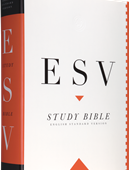
ESV Study Bible (General Editor)
The ESV Study Bible was created to help people understand the Bible in a deeper way. Combining the best and most recent evangelical Christian scholarship with the highly regarded ESV text, it is the most comprehensive study Bible ever published.
The ESV Study Bible features more than 2,750 pages of extensive, accessible Bible resources, including completely new notes, full-color maps, illustrations, charts, timelines, and articles created by an outstanding team of 93 evangelical Christian scholars and teachers. In addition to the 757,000 words of the ESV Bible itself, the notes and resources of the ESV Study Bible comprise an additional 1.1 million words of insightful explanation and teaching-equivalent to a 20-volume Bible resource library all contained in one volume.
Purchase this book -
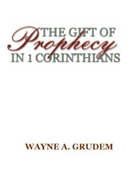
The Gift of Prophecy in 1 Corinthians (Wayne Grudem’s Ph.D. dissertation)
This is a published copy of my Ph.D. dissertation written at the University of Cambridge, England, under Professor C. F. D. Moule and first published in 1982 by University Press of America. I am thankful that Wipf and Stock have now reprinted it because it is still frequently referred to in discussions about the gift of prophecy. This version contains about 40,000 words of scholarly interaction and detailed exegesis which are not found in my more popular book on prophecy, The Gift of Prophecy in the New Testament and Today (Crossway Books, second edition, 2000). I based that book on this earlier, more academic work.
I am still in substantial agreement with what I wrote in this earlier book and I hope it will continue to be useful for people in considering what the gift of prophecy was in the New Testament church.
Purchase this book -
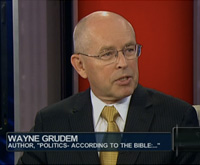
-
Pastoral Leadership for Manhood and Womanhood (co-edited with Dennis Rainey)
(300 pages. This book contains 15 practical papers that were presented March 20-22, 2000, at a conference sponsored by the Council on Biblical Manhood and Womanhood in Dallas, Texas.)
As the shepherd of the flock, a pastor has many responsibilities–few as great as leading and training families.The pervasive attitude and beliefs of the world have only added stress and confusion to this task. Sixteen highly regarded men and women help bring clarity and guidance to this important issue. They tackle practical topics such as how and why to preach on biblical manhood and womanhood, putting the Internet to use, church discipline, small groups, and handling domestic violence. They discuss the personal applications within the pastor’s marriage, and they examine the biblical views of ministering to singles, homosexuality, leadership and submission, and much more. This compilation is thorough, potent, and a must-have for any pastor’s library.
Purchase this book -

-
Translating Truth: The Case for Essentially Literal Bible Translation (contributor)
In an age when there is a wide choice of English Bible translations, the issues involved in Bible translating are steadily gaining interest. Consumers often wonder what separates one Bible version from another.
The contributors to this book argue that there are significant differences between literal translations and the alternatives. The task of those who employ an essentially literal Bible translation philosophy is to produce a translation that remains faithful to the original languages, preserving as much of the original form and meaning as possible while still communicating effectively and clearly in the receptors’ languages.
Translating Truth advocates essentially literal Bible translation and in an attempt to foster an edifying dialogue concerning translation philosophy. It addresses what constitutes”good” translation, common myths about word-for-word translations,and the importance of preserving the authenticity of the Bible text. The essays in this book offer clear and enlightening insights into the foundational ideas of essentially literal Bible translation.
Purchase this book -
The TNIV and the Gender-Neutral Bible Controversy (co-authored with Vern Poythress)
“The Bible is God’s own Word to us.” Translating the words of God has become an even more daunting task in recent years as the pressure of “political correctness” and various activist agendas have sought to influence the landscape. No issue has become more controversial than gender-neutral Bible translations, especially with the release of the TNIV.
Vern Poythress and Wayne Grudem examine the translation practice of replacing the generic “he” and the specific “father” with the gender-neutral “they” and “parent” with special attention focused on the TNIV. While translators may be well intentioned in seeking not to offend, Poythress and Grudem contend that the results are subtly changing meanings of the original texts.
The authors seek to build a dialogue that will result in understanding both sides of the gender-neutral controversy and the challenge of producing accurate Bible translations.
Purchase this book -
-
What Are The Consequences of Divorce? (1996)
A Summary of Some of the Findings in the Book: Second Chances: Men, Women, & Children a Decade After Divorce by Judith S. Wallerstein & Sandra Blakeslee (New York: Ticknor & Fields [Houghton Mifflin], 1989)
-
Amicus brief filed with Supreme Court in CLS v Martinez (2010)
BRIEF OF AMICI CURIAE EVANGELICAL SCHOLARS (OFFICERS AND 24 FORMER PRESIDENTS OF THE EVANGELICAL THEOLOGICAL SOCIETY), EVANGELICALS FOR SOCIAL ACTION, AND NATIONAL ASSOCIATION OF EVANGELICALS, IN SUPPORT OF PETITIONER (Wayne Grudem was the primary author of the drafts which were reviewed and corrected by several lawyers and which then resulted in this brief.)
-
How can I find your book Systematic Theology in other languages?
Translation contact information for Systematic Theology by Wayne Grudem (Leicester, England: IVP, and Grand Rapids, Michigan: Zondervan, 1994). 1290 pages.
Translation permission for Systematic Theology is handled by Stephen Tyers at InterVarsity Press in Leicester, England. E-mail: st@ivpbooks.com
Translation permission for Bible Doctrine (528 pages) and Christian Beliefs (160 pages) is handled by Zondervan, Grand Rapids, Michigan. (616-698-6900). Contact Seamus Dillion seamus.dillion@zondervan.com or Angela Tegg angela.tegg@zondervan.com.
The following information is current as of April 24, 2016:
A. Completed translations of Systematic Theology:
1. Korean (in 3 vols)
Eunsung Publishers
126-60 Sangdo 5-dong
Dongjak-gu
Seoul
Korea
Fax: 82-2-813-9072
Email: esp4404@hotmail.com2. Portuguese
Edicoes Vida Nova,
Caixa Postal 21.486,
CEP 04602-970,
Sao Paulo, Brazil.
Phone/Fax (+55 11) 5666-1911
Email: vidanova@vidanova.com.br3. Arabic (in 3 vols)
The Program for Theological Education by Extension
P.O. Box 1931
Amman 11118
Jordan
Phone/Fax: (962) 6 4610982
Email: pteemail@ptee.org4. Russian – published early 2005. (MIRT publishers). ISBN 5-88869-160-7
5. Romanian: published in late 2004 or perhaps January 2005. Slavic Gospel Association in Europe has taken leadership on this but I don’t have contact info.
6. Spanish: published in 2007. Teología Sistemática (Miami, FL: Editorial Vida, 2007). ISBN 13-978-0-8297-4627-3.
7. French: published in 2010. Théologie Systématique. (Charols, France: Excelsis SARL, 2010). ISBN 978-2-7550-0105-1. www.XL6.com.
8. Chinese (Mandarin): published (in traditional Chinese characters) in May, 2011. Christian Renewal Mission, Blk 203 Hougang Street 21, #02-89, Singapore 530203. E-mail: crmsg77@yahoo.com.sg or crm7hk@gmail.com. Translator: Paul Chang. The contract is for publication in both “Regular Script” and “Simplified Script.”
9. Amharic (in Ethiopia): vol. 1 published early 2013, vol. 2 expected soon after that. Published by Bible Based Books (SIM Publishing) and Kale Heywet Church.
10. German: Published June, 2013, by Verlag für Kultur und Wissenschaft.
http://www.vkwonline.de/biblische-dogmatik.html.
Also available from Amazon.com in Germany: http://www.amazon.de/Biblische-Dogmatik-Einf%C3%BChrung-systematische-Theologie/dp/386269066011. Jinghpaw (Kachin people – Northern Myanmar): volume received 4-7-14. Sponsored by Bethlehem Baptist Church, Minneapolis. [no publisher, location, or date given in the volume]
12. Italian: Published December, 2014. Teologia Sistematica (Chieti Scalo, Italy: Edizioni GBU, 2014.) ISBN 978-88-96441-64-0. Contact: Edizioni GBU, Via Colonnetta 80, 66013 Chieti Scalo, ITALIA. Cell. (+39) 345 5217945 http://www.edizionigbu.it (Also available from Amazon.it in Italy: https://www.amazon.it/Teologia-sistematica-Introduzione-principali-dottrine/dp/8896441641 )
B. Translations under contract and in progress for Systematic Theology, but not yet published
1. Albanian: Permission granted to Center for Christian Leadership in Tirana. They are aiming for a digital publication, probably in 2017.
2. Tamil: in process (Sri Lanka)
3. Nepali: permission given April 4, 2007.
4. Swahili: Discussions underway.
5. Tajik: for Tajikistan. Agreement signed Nov. 5, 2010.
6. Hindi: for India: Agreement in negotiation, Dec. 2010.
C. Translations of Bible Doctrine (528 pages)
The shorter form of Systematic Theology, a 528-page book called Bible Doctrine, has been made available in some foreign translations. I am aware of the following:
1. Chinese: 3 vols. in Chinese (3 vols., published April 2002). It was produced by Fellowship of Evangelical Students in Hong Kong, and the e-mail address for the publisher is publish@fes.org.hk. The ISBN is 962-8266-6.
2. Spanish: Published as Doctrina Biblica by Vida publishers (Miami), 2005. (Vida is a subsidiary of Zondervan).
2. Turkish: translation of Bible Doctrine published in 2005. (Yeni Yaşam Yayınları) ISBN: 9758318829
www.yyyayinlari.com3. Mongolian: Translation of Bible Doctrine published in 2008.
Publisher: Библийн Сургалтын Төв
Address: Bibliin Surgaltiin Tuv, Bayazurkh District, 2nd khoroo, 805 dugaar angiin khashaand, Ulaanbaatar, Mongolia
Mailing Address: POB-473, Ulaanbaatar-49, Mongolia
Phone: 976-11-462909
Fax: 976-11-462910D. Translation permission, DVDs, audio files, other notes:
2. DVD lecture series: There is now a set of 20 of my theology lectures, 40 minutes each plus 15 min. Q & A, on DVDs. These lectures cover the 20 basic doctrines discussed in Christian Beliefs, a short, 160-page version of Systematic Theology.
The DVDs are available from ClearCutMedia in the UK. http://www.clearcutmedia.tv/shop/
(Available in European format but not yet in US/ Canada format – expected in early or mid-2010.)3. Audio lecture series: Wayne Grudem taught through the entire contents of Systematic Theology for an adult Bible class at Scottsdale Bible Church in 2005-2009. Most of these audio lessons (plus outlines) are available from this web site:
http://www.christianessentialssbc.com/messages/4. CD of Systematic Theology for installation on your computer: Available from Bits&Bytes Computer Resources, 623 N. Iowa Ave, Whitefish, MT 59937. E-mail: info@bitsbytescomputer.com. Phone 800-361-7280. fax 406-862-0876.
5. Other electronic forms: Systematic Theology is available in several electronic forms from www.Amazon.com.
It is also available from OliveTree.com for several PDA formats. -
What is your opinion about President Obama’s May 9 endorsement of same-sex “marriage”?
This is a great disappointment and a direct challenge to the moral standards taught in the Bible, which I believe to be the Word of God.
I cannot think of another instance where an American president has declared himself to be in such direct contradiction to the moral teachings of the Bible (see Romans 1:26-27).
The institution of marriage is a way for society to decide what kind of relationship it will promote by calling it “marriage” and giving it numerous legal and financial benefits. For centuries, societies have decided that they will promote marriage between one man and one woman because that is by far the best relationship for raising the children of the next generation, and also the best protection for women against abandonment and the best way to encourage men in socially beneficial pursuits. Society has a strong interest, therefore, in promoting marriage between one man and one woman. We should treat homosexuals with love and kindness, but government should not promote such relationships by calling them “marriage.”
But in this announcement, President Obama has given a clear signal of his agenda if he wins reelection. His administration will continue to actively promote (through laws and policies) a sexual relationship that is contrary to the Bible, contrary to most people’s moral instincts (according to how they consistently vote, even if they aren’t willing to tell that to pollsters), contrary to the way God designed our human bodies to function, and, sadly, harmful to the parties involved, harmful to the next generation of children, and harmful to the nature of marriage itself as understood through all societies in previous human history. (See the discussion in my Politics — According to the Bible, chapter 7.)
In addition, supporters of same-sex “marriage” have already shown that they will promote social and economic ostracism and sometimes even criminal penalties (for “hate speech”) against anyone who expresses public opposition to their view. Such conduct significantly threatens freedom of speech, freedom of conscience, and freedom of religion in our nation.
What does this mean for President Obama’s future? The Bible also says that God is sovereign over the affairs of nations. “The Most High rules the kingdom of men and gives it to whom he will” (Daniel 4:25 ESV). Also, “it is God who executes judgment, putting down one and lifting up another” (Psalm 75:7 ESV).
I will watch carefully for the next several months to see whether this sovereign God will bless or frustrate the plans of a national leader who takes the stand President Obama has taken. I do not expect that God will bring blessing to a president who has taken such a stand.
I have discussed this issue at some length in a recent podcast in Minnesota. KTIS radio podcast – Minnesota
-
I see that you endorsed John Piper’s book, This Momentary Marriage. Does this mean that you agree with Piper’s view that remarriage is never justified after a divorce?
No, I do not agree with my friend John Piper on that matter. But I thought I could endorse the book anyway because there is so much excellent material in it.
My own view of divorce and remarriage is expressed well in the article on marriage, divorce, and remarriage in the ESV Study Bible (pp. 2545 – 2547), and also in the ESV Study Bible notes on Matthew 5:31-32; Matthew 19:3-9; Mark 10:2-12; Luke 16:18; and 1 Corinthians 7:15.
In brief, my own view is the mainstream evangelical Protestant view since the Reformation, the position which is also represented in the Westminster Confession of Faith (1646). In brief, that position is that marriage is a life-long commitment, but that divorce is morally justified, and is not sin in God’s sight, if the other spouse (a) has committed adultery, or (b) has abandoned the marriage and all attempts at reconciliation have failed.
In such cases where divorce is morally justified, it is allowed by God but not necessary, and, if possible, reconciliation and attempting to preserve the marriage should be the first choice. But when a divorce has occurred for one of these reasons, then the marriage no longer exists, and the spouse who obtained a divorce because of such a reason is viewed as a single person in God’s sight and is free to marry someone else. (See the ESV Study Bible notes referenced above for further explanation).
-
Why did you move from Trinity Evangelical Divinity School to Phoenix Seminary in 2001?
The short answer is that I moved because of my wife Margaret’s health. That is explained in this article:
But now after several years I can see that God had additional purposes for this move, because the time here has been wonderfully blessed by God through fellowship with faculty colleagues, through relationships with students, through Scottsdale Bible Church, and through many other circumstances that have made it possible for me to be very productive in my writing projects (see books section).